Self-assessment · 20 questions · 10 minutes

SST quiz: are you ready to give first aid?

Twenty questions on the skills of a French Workplace First Aider (SST), from raising the alarm to the technical details of CPR, with explained answers.
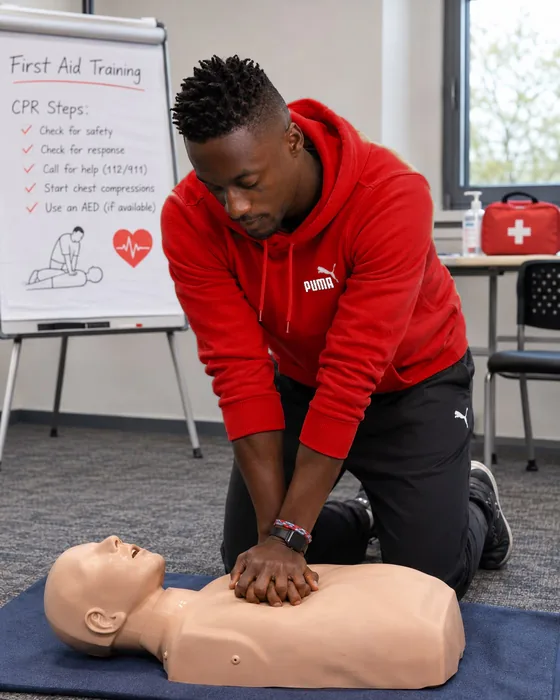
Josselin Wide André, kneeling in a red hoodie, performs chest compressions on a training manikin in front of a flipchart listing the CPR steps.

SST quiz

This quiz is for practice only. It does not replace hands-on training or the SST certification assessment, which take place through scenarios with a certified trainer.

  1. Question 1/20 You are first on the scene where a colleague has had an accident. What do you do first?

    The right answer: Spot the ongoing danger and remove or isolate it. First, prevent a second accident: spot any ongoing danger (machinery, electricity, traffic…) and remove or isolate it, for the victim, bystanders and yourself.

  2. Question 2/20 A colleague has been electrocuted and is still touching a live machine. What do you do?

    The right answer: Cut the power before any contact with the victim. As long as the victim is in contact with the current, touching them puts you at risk. Cut the power first (emergency stop, circuit breaker), then give first aid.

  3. Question 3/20 Which number puts you straight through to the SAMU emergency medical service in France?

    The right answer: 15. 15 is the SAMU. 18 is the fire brigade, 112 the European emergency number and 114 the emergency number for deaf or hard-of-hearing people (by text or app). 17 is the police.

  4. Question 4/20 When calling the emergency services, what should you do?

    The right answer: Give location, situation and actions; hang up when told to. The alert must help the emergency services arrive quickly with the right equipment: exact location, type of accident, number of victims, apparent condition, actions taken. Only hang up when the operator tells you to.

  5. Question 5/20 A victim is bleeding heavily from the forearm. What is your priority?

    The right answer: Press firmly and directly on the wound. For severe bleeding, direct pressure on the wound is the priority. Protect your hand (glove, plastic bag) if possible, lay the victim down and have someone call for help.

  6. Question 6/20 When is a tourniquet appropriate?

    The right answer: When direct pressure fails or is impossible. A tourniquet is applied to a limb when direct pressure is impossible (inaccessible wound, several victims, rescuer needed elsewhere) or ineffective. Note the time it was applied and never loosen it yourself.

  7. Question 7/20 A colleague has a nosebleed. What should they do?

    The right answer: Head forward, pinch the nostril for 10 minutes. With the head tilted back, blood runs into the throat and can cause vomiting. Lean forward and pinch the bleeding nostril; if bleeding does not stop or follows a fall, seek medical advice.

  8. Question 8/20 A conscious adult is choking: they cannot speak, shout or cough. What do you do?

    The right answer: Up to 5 back blows, then up to 5 abdominal thrusts. For a complete airway obstruction in an adult, alternate sets of 5 firm back blows and 5 abdominal thrusts until the airway is cleared. If the person can still cough, simply encourage them to keep coughing.

  9. Question 9/20 A pregnant woman is choking and back blows have not worked. What do you do next?

    The right answer: Chest thrusts in the middle of the chest. For a pregnant woman (or an obese person whose abdomen you cannot encircle), abdominal thrusts are replaced by chest thrusts in the middle of the chest.

  10. Question 10/20 An infant is choking and can no longer cry or breathe. What should you do?

    The right answer: Back blows, then chest thrusts with 2 fingers. For an infant, give up to 5 back blows with the baby face down along your forearm, head lower than the body, then if needed 5 chest thrusts with two fingertips. No abdominal thrusts.

  11. Question 11/20 A victim does not respond. How do you check whether they are breathing?

    The right answer: Tilt the head, lift the chin, check for 10 seconds. Tilting the head back and lifting the chin opens the airway. Then check for breathing (chest movement, sound, breath) for no more than 10 seconds, so as not to delay resuscitation.

  12. Question 12/20 A victim does not respond but is breathing normally. What should you do?

    The right answer: Recovery position, call for help, monitor. An unconscious person who is breathing may choke on their back (tongue, vomit). The recovery position keeps the airway clear. Have someone call for help and monitor breathing until help arrives.

  13. Question 13/20 After opening the airway, you find the victim is not breathing at all. What do you do?

    The right answer: Call for help, CPR, send for a defibrillator. This is a cardiac arrest: every minute counts. Have someone call for help, start CPR straight away and use a defibrillator as soon as one is available.

  14. Question 14/20 The victim does not respond and is not breathing normally: only a few isolated, slow, noisy breathing movements ("gasps") occur. What do you do?

    The right answer: No real breathing: call for help, CPR, defibrillate. Gasps are not breathing: they are isolated reflex movements that sometimes persist in the first minutes of a cardiac arrest, without bringing in air. Guidelines (INRS, European Resuscitation Council) say to treat them as breathing having stopped. So it is indeed the absence of breathing that triggers CPR. Do not confuse them with the normal, regular breathing of an unconscious victim, who goes in the recovery position.

  15. Question 15/20 Where do you place your hands for chest compressions on an adult?

    The right answer: Centre of the chest, lower breastbone. Place the heel of one hand in the centre of the chest, on the lower half of the breastbone, with the other hand on top and arms straight. Pressing on the side or on the abdomen is ineffective and can cause injury.

  16. Question 16/20 How deep should each chest compression be on an adult?

    The right answer: 5 to 6 cm. On an adult, push the chest down 5 to 6 cm, at 100 to 120 compressions per minute, letting it come back up fully each time. Compressions that are too shallow do not circulate blood.

  17. Question 17/20 When a trained rescuer resuscitates an adult, what is the recommended sequence?

    The right answer: 30 compressions, then 2 rescue breaths. Alternate 30 chest compressions and 2 rescue breaths. If you cannot or will not give rescue breaths, give continuous compressions: it is always better than doing nothing.

  18. Question 18/20 Where do the defibrillator pads go on an adult?

    The right answer: Below the right collarbone and on the left side, below the armpit. The pads frame the heart: one below the right collarbone, the other on the left side a few centimetres below the armpit. The diagram is printed on the pads, and the defibrillator gives voice prompts.

  19. Question 19/20 A colleague suddenly has a drooping mouth, a weak arm and difficulty speaking. What do you do?

    The right answer: Call 15 and note when the signs began. These signs suggest a stroke, an absolute emergency: every minute counts for treatment. Call 15 straight away, note when the signs began and make the person comfortable.

  20. Question 20/20 Outside emergencies, what is the role of an SST in the company?

    The right answer: Spot and report dangerous situations. A Workplace First Aider also contributes to prevention: they spot dangerous situations at work and report them to their managers or to the people in charge of prevention.

Contact and quotes

Let's talk about your project

SST training, first aid awareness, a fitness session or coaching: describe your need and receive a free, tailored quote.

  • Area covered: Essonne (91) · Paris region · up to 3 hours' drive

Fields marked with an asterisk (*) are required.

Expected format: name@domain.com
Expected format: +33 6 12 34 56 78
Number of participants, location, preferred dates…